aFine Arts Specialist, Cross-Cultural Dance Resources Collections, School of Music, Dance and Theatre, Arizona State University, Tempe, AZ, 0009-0003-4131-4081, srchuah@asu.edu
Rann. All works in Hypothesis are licensed under a CC BY-NC 4.0 DEED Attribution-NonCommercial 4.0 International . Authors own copyright of their articles appearing in Hypothesis. Readers may copy articles without permission of the copyright owner(s), as long as the author(s) are acknowledged in the copy, and the copy is used for educational, not-for-profit purposes. For any other use of articles, please contact the copyright owner(s).
Abstract
This visual essay examines the Neijing Tu (Chart of the Inner Landscape), which is a nineteenth-century Daoist diagram that represents the human body as sacred geography. Through visual analysis of its mountain metaphor and cosmological symbolism, it explores how historical body imagery encodes culturally specific models of wellness and invites health information professionals to reflect on the role of visual systems in communicating health knowledge.
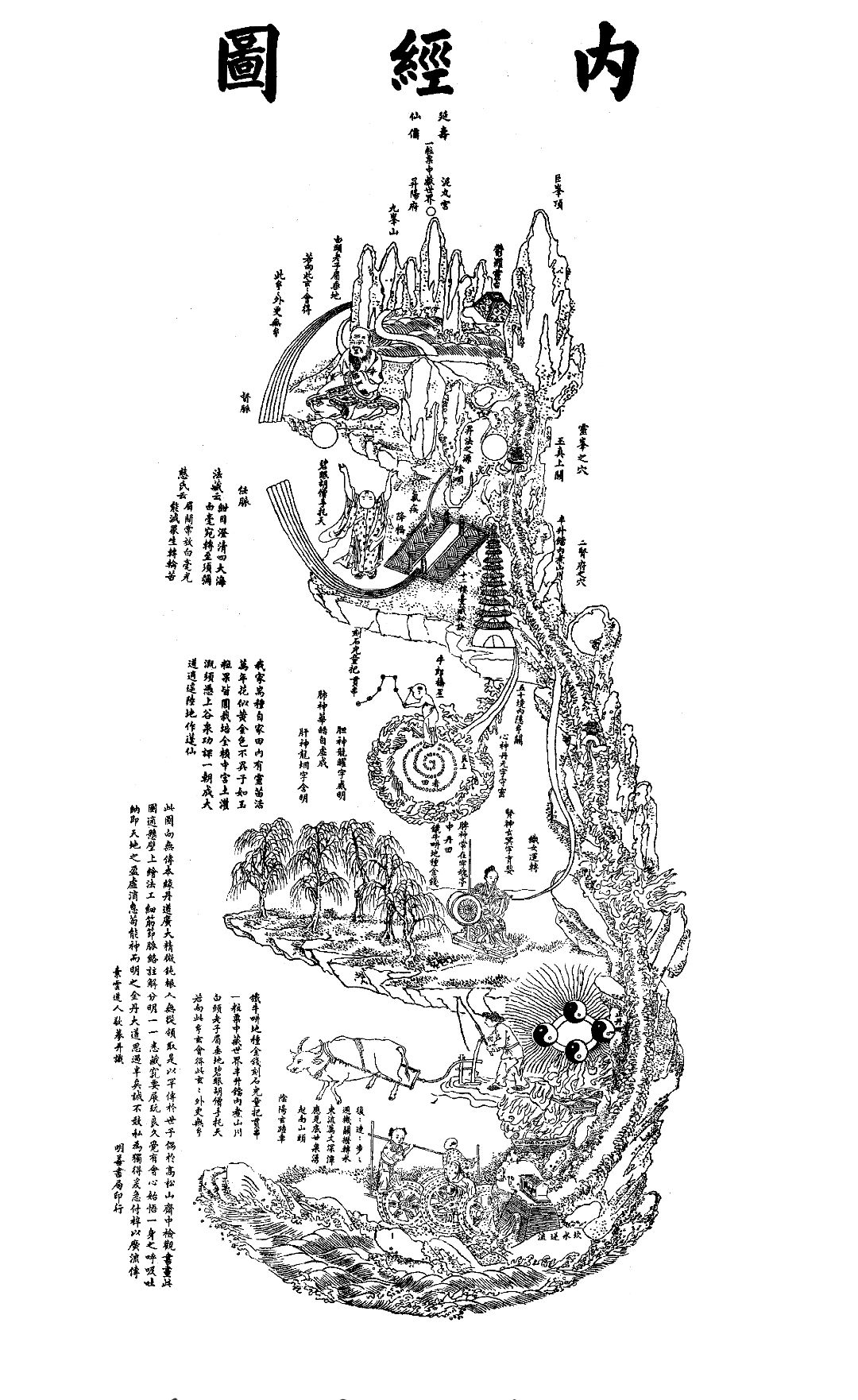
The Neijing Tu (内经图) is a Daoist diagram that visualizes internal alchemy (neidan) through a symbolic mapping of the human body1. Often translated as the "Chart of the Inner Landscape," it reimagines the body as a microcosm of the cosmos, where mountains align with vertebrae, rivers with meridians, and internal organs with celestial realms. The spine is depicted as a semi-elliptical ridge, with a watercourse flowing from the head, figured as Mount Kunlun, the mythic axis of the universe2. This body map integrates Daoist cosmology with traditional Chinese medical physiology, reflecting the historical interconnection between internal cultivation practices and the development of Chinese medicine.
Health is understood as the harmonious circulation of qi, or vital energy, achieved by reenacting heaven and earth within the body through a process of cosmological alignment that Joseph Needham describes as "microsomography3". This study examines the engraved stele dated 1886 at Beijing’s White Cloud Temple, a widely circulated version of the Neijing Tu. Through close visual analysis and historical contextualization, it considers how landscape metaphors encode an esoteric yet systematic model of embodiment. The diagram functions as both an instructional guide and a contemplative map, incorporating Daoist medico-philosophical concepts such as taiji (yin-yang), the dantian (elixir fields), and the circulation of qi through the Ren and Du vessels4. Visual systems function as epistemological frameworks that shape how knowledge is organized and interpreted. The objective of this work is to examine how classical Daoist body imagery can expand contemporary understandings of wellness and the communication of health knowledge5. By engaging the Neijing Tu as both artwork and epistemological framework, the project highlights alternative ways of visualizing the body beyond biomedical conventions. In contemporary China, the Neijing Tu continues to inform practices of internal alchemy and health cultivation, demonstrating the enduring influence of Daoist conceptions of the body on Chinese medicine and health practices. Engaging such imagery broadens interpretive approaches to human physiology and underscores the importance of culturally situated knowledge systems in the communication of health information across diverse populations.
CRediT Statement
Shanny Rann conceptualized the project, analyzed the visual material, and wrote the manuscript.
Image Credit
Wikimedia Commons. Faithful photographic reproduction of the Neijing Tu engraved stele (1886), White Cloud Temple, Beijing. Public domain under PD-Art (PD-US-expired).
References
Neidan. Neijing Tu (Chart of the Inner Landscape) [photograph of engraved stele]. Wikimedia Commons. Published July 23, 2010. Accessed March 2, 2026. Available from: https://commons.wikimedia.org/wiki/File:NeijingTu1.jpg
Despeux C. Taoism and self-knowledge: the chart for the cultivation of perfection (Xiuzhen tu). Leiden (NL): Brill; 2018.
Needham J. Science and civilisation in China. Vol 5, pt 5. Cambridge (UK): Cambridge University Press; 1983.
Kohn L, ed. Daoist body cultivation: traditional models and contemporary practices. Honolulu (HI): University of Hawaii Press; 2006.
Rann S. Week 1: Ancient views of the body. Lecture presented at: DCE 405: Writing the Creative Body; 2024; Arizona State University.
